Assuming by "going long" means that the MUF for short distance reception has dropped below 6925 already?
Exactly. The ionosphere won't support the steep incidence angles any longer. Typically during the daytime, the ionosphere will reflect back radio waves that are even perfectly vertically incidence (aka NVIS) on 43 meters. At some point, as you get late enough in the day, and the ionization in the F layer decreases, you reach a point where a radio wave directly straight up will no longer be reflected back, but will instead go off into space. (In reality, you often do get some of the signal back, so the signal level may be very weak, but still there) Then waves at slightly lower angles also stop getting reflected back. This continues, so you're left with an area of possible reception that looks somewhat like a doughnut - there is a center area around the transmitter where the signal is either very weak or inaudible, then a ring where you can hear the station, then more distant areas where you can't.
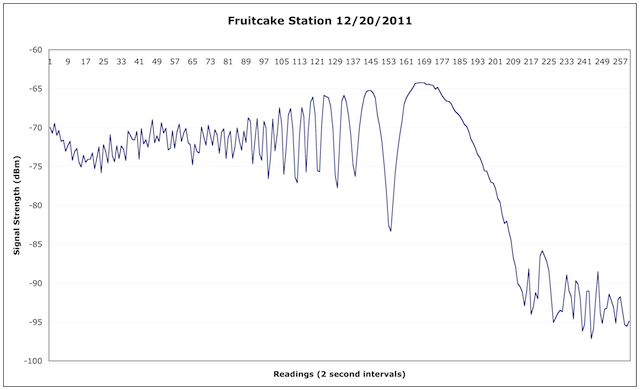
One interesting feature of this is that areas very close to the center skip zone, but in the ring where the station can be heard, usually receive the station with a very strong signal. Then as the skip zone expands, the signal level may actually slightly increase more, then become very fluttery with sharp fades and high peaks. The periods of these peaks and fades will be very short and fast, then get slower (longer) until there is one long peak, followed by a deep fade that never ends. Here's a signal strength plot showing that:
You can see it on the waterfall also:
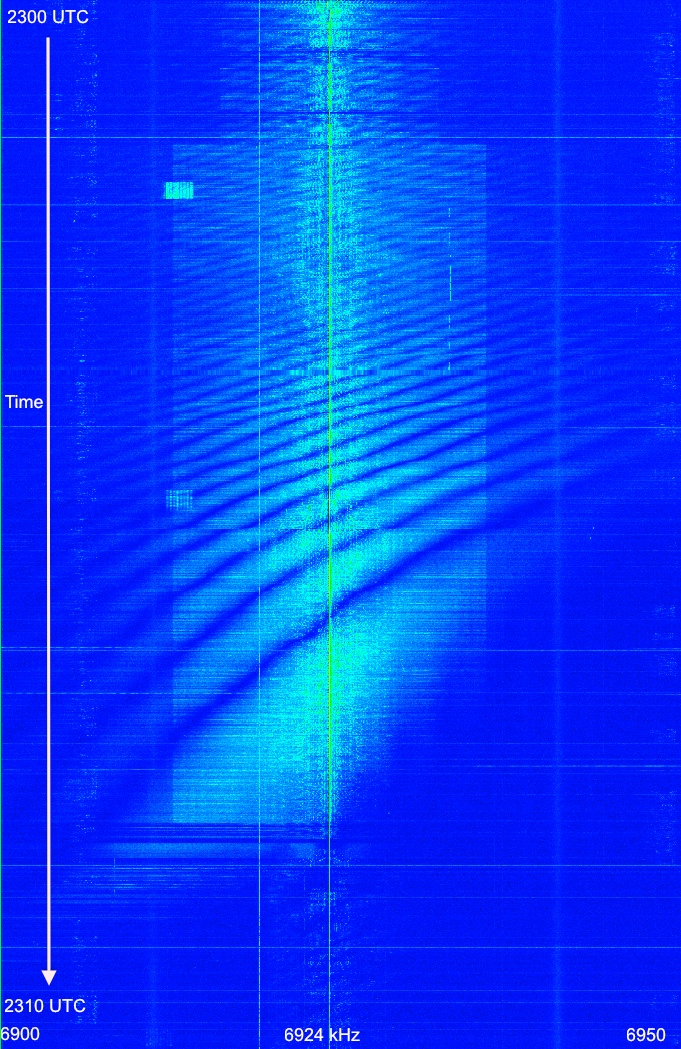
Note how the deep fades vary in frequency, this is the "selective fading" you have heard about before.
After going long, the station is still there, you can hear it and see it in the waterfall, but it is much weaker. It went from S9+ to S5, and just above the noise floor. The signal will often continue to decrease in strength, eventually, you can't hear it at all.


 Topic: Propagation Observation (Read 3113 times)